Dainty beaded bracelets bring a quiet kind of beauty to everyday dressing. A slim strand of tiny beads can add color, texture, or a gentle metallic shine without overwhelming an outfit. Worn alone, it feels simple and intentional. Worn with other bracelets, it becomes part of a more personal arrangement, revealing small details about the wearer’s taste.
Their appeal lies in their variety. Some feature polished gold-colored beads, while others combine delicate pearls, colorful glass, or small gemstone beads. A bracelet might feel minimal and modern, soft and romantic, playful and handmade, or warm and slightly vintage. Even when two bracelets share the same delicate proportions, their materials and colors can create entirely different impressions.
Choosing one is therefore about more than finding the prettiest photograph. The size of the beads, the length of the bracelet, the closure, and the way it moves on your wrist all shape the experience of wearing it. A beautiful bracelet should not only look appealing in a product image; it should also suit your routine and feel comfortable with the clothes you actually wear.
This guide explores how to choose dainty beaded bracelets, compare their details, build balanced stacks, and make them part of your everyday style.
What Makes a Beaded Bracelet Feel Dainty?
Delicate Proportions Rather Than One Fixed Size
The word “dainty” describes an overall impression rather than a single measurement. A bracelet feels dainty when its proportions appear light, refined, and relatively understated. Small beads often contribute to that effect, but bead size is only one part of the design.
Spacing also matters. Tiny beads separated by short sections of fine chain may feel airier than the same beads arranged in a continuous strand. A narrow bracelet with a small clasp can appear more delicate than one with a large decorative closure, even when both use similar beads.
Your wrist and styling choices influence the impression too. A bracelet that looks extremely subtle on one person may feel more noticeable on another. Instead of relying only on the word “dainty” in a description, look for measurements and photographs that show the bracelet being worn.
The most useful question is not whether a bracelet meets an exact definition. It is whether the design gives you the amount of presence you want.
Small Details Create the Overall Character
Dainty beaded bracelets reward a closer look. Their personality often comes from details that are easy to miss at first: a single contrasting bead, an off-center pearl, a softly colored cord, or a tiny charm near the clasp.
A bracelet made entirely from round metallic beads creates a different rhythm from one that alternates smooth and faceted shapes. Likewise, a strand of matching beads feels more uniform than a design with subtle variations in color or outline.
These differences help explain why a simple bracelet can still feel distinctive. Delicacy does not have to mean plainness, and decorative detail does not have to mean excess.
When comparing designs, identify the feature that attracts you most. Perhaps it is the color, the bead texture, or the contrast between two materials. Recognizing that preference makes it easier to choose a bracelet you will enjoy repeatedly rather than one that only looks appealing for a moment.
Explore the Main Styles of Dainty Beaded Bracelets
Dainty beaded bracelets for ladies can range from understated metallic strands to colorful designs with pearls, glass beads, or small charms. Rather than choosing by category alone, think about the mood you want your jewelry to create. A simple strand can feel polished and discreet, while a bracelet with contrasting colors or an unusual bead arrangement can express a more playful side. The most appealing choice is one that feels connected to your own wardrobe and personal taste.
Minimal Metallic Bead Bracelets
Metallic bead bracelets are a natural starting point for anyone who prefers a clean, streamlined look. Their repeating shapes create a simple line around the wrist, while their finish provides the main visual interest.
Gold-colored beads can bring warmth to an outfit. Silver-colored beads can create a cooler, sharper impression. Rose-colored finishes offer another option for people who enjoy softer metallic tones.
The design can remain completely uniform or include a small interruption, such as a pearl, a charm, or a contrasting bead. That single change can make the bracelet feel more personal without taking away its simplicity.
For everyday styling, consider whether you want the bracelet to echo your existing jewelry or introduce a deliberate contrast. Matching it to a favorite ring creates continuity. Choosing a different metallic color can make the combination feel more relaxed and individual.
Colorful Seed Bead Bracelets
Seed bead bracelets offer color in a compact, delicate format. Some use a single shade throughout, while others create stripes, repeating patterns, or small decorative motifs.
A narrow bracelet in cream, blush, or soft blue can feel understated. A design in turquoise, orange, green, or mixed bright colors brings more energy to the wrist without requiring large beads.
Colorful dainty beaded bracelets are especially appealing when you want jewelry to feel expressive rather than formal. They can pick up a color from your clothing, introduce an unexpected accent, or remind you of a favorite place or season.
Look closely at how the colors are arranged. A repeated pattern usually feels more orderly, while an irregular combination can appear playful. Neither is inherently better. The right choice depends on whether you prefer visual consistency or a more spontaneous character.
Pearl and Gemstone Bead Bracelets
Pearls and gemstone beads give delicate bracelets another kind of visual depth. Instead of depending only on shine or bright color, they introduce differences in surface, translucency, and shape.
A bracelet with small pearl accents may feel soft and slightly dressier. A continuous pearl strand creates a more consistent impression, while pearls mixed with metallic or colored beads can feel less traditional.
Gemstone bead bracelets can range from nearly neutral to richly colored. Pale, muted shades are easy to combine with everyday clothing. Stronger colors can become the main accent in an otherwise simple outfit.
Before buying, read the material description carefully. A photograph alone may not tell you whether a pearl is cultured or imitation, or whether a bead is a natural stone, treated stone, glass, or another material. Choose for appearance, but understand what the seller is actually offering.
Mixed Beads, Charms, and Handmade Details
Some of the most distinctive dainty beaded bracelets combine several elements in one narrow design. A strand might include tiny metallic beads, a few colored accents, and a small charm.
The charm can provide a clear focal point, while the surrounding beads keep the bracelet light. Alternatively, a design may avoid a centerpiece and rely on subtle variations throughout the strand.
Handmade styles can also appeal to people who prefer jewelry with visible individuality. Slight differences in arrangement or bead shape may contribute to that feeling, depending on the design.
When choosing a mixed bracelet, check whether the elements look balanced together. A charm that is much larger than the beads may shift the bracelet away from the delicate look you want. Consider the whole composition rather than judging each decorative piece separately.
Understand Materials Before Choosing a Bracelet
Read Beyond the Color Description
“Gold,” “silver,” and “pearl” can describe appearance in casual product language, but they do not always provide enough information about composition. A bracelet that looks gold-colored may use several different materials or finishes.
Look for a description that distinguishes the base material from any coating or decorative treatment. If the bracelet combines beads, a clasp, an extender, and a charm, check whether the seller describes those components individually.
This is particularly useful when you have material preferences or know that certain jewelry components have bothered your skin before. A clear description allows you to make a more informed decision.
Avoid assuming that appearance tells the whole story. Two bracelets may look similar in photographs while differing in construction, finish, and care requirements. Those differences can matter more over time than a small variation in color.
Compare the Entire Construction
The beads are only part of a beaded bracelet. The material holding them together also affects how the bracelet behaves.
An elastic bracelet stretches over the hand. A bracelet with a clasp opens and closes around the wrist. A cord bracelet may use an adjustable knot or sliding closure. A design built with chain sections may drape differently from a fully strung strand.
Look at the transitions between components. Are the beads connected with visible links? Is there an extender? Does the bracelet have a decorative end detail? These features influence both appearance and handling.
A useful product description should help you understand how the bracelet is put together, not merely list its colors. If essential construction details are missing, ask for clarification before purchasing, especially when the bracelet is intended for frequent wear.
Treat Performance Claims Carefully
Descriptions such as “waterproof,” “hypoallergenic,” or “tarnish-free” can sound reassuring, but they should not replace specific material and care information.
Before relying on a broad claim, look for the conditions attached to it. Does the seller provide clear care instructions? Does the claim apply to every component? Is there an explanation of the materials used?
For personal comfort, your own history matters too. If you already know that a particular metal or finish causes problems for you, choose accordingly rather than assuming every delicate bracelet will behave the same way.
A thoughtful purchase does not require complicated research. It requires enough information to match the bracelet to your expectations. When a description is vague, it is reasonable to ask questions rather than fill in the gaps yourself.
Find a Comfortable Fit
Measure Your Wrist First
Fit deserves attention because even a beautiful bracelet can become frustrating if it feels too tight or moves more than you want.
Start by measuring around the part of your wrist where you expect to wear the bracelet. A flexible measuring tape is convenient. You can also wrap a strip of paper around your wrist, mark the overlap, and measure the strip with a ruler.
Then compare your wrist measurement with the seller’s sizing instructions. Do not assume that your wrist measurement and your ideal bracelet length are identical. The finished fit also depends on the bead dimensions, the closure, and the amount of movement you prefer.
If a product offers several sizes, check how those sizes are defined. Some descriptions refer to total bracelet length, while others explain the intended wrist fit. Clear sizing information is more useful than labels such as small, medium, or large alone.
Dainty Bracelets for Small Wrists
Dainty bracelets for small wrists should offer more than delicate-looking beads; they should also provide a suitable fit. When comparing designs, check the shortest available length, the adjustment range, and the seller’s explanation of how the bracelet is measured. A bracelet described as dainty may still be too loose for your wrist, so judge its dimensions separately from its style.
Think about the proportions of the whole piece, including the clasp, charm, and extender. If you prefer a particularly subtle look, choose details that feel balanced on your wrist rather than focusing only on bead size. Before ordering, ask whether a shorter length is available if the listed measurements do not suit you.
Decide How Much Movement You Like
Some people enjoy a bracelet that stays close to the wrist. Others prefer a looser drape that moves gently with the hand.
Think about how you use your hands during the day. If you spend long periods typing, drawing, or working at a desk, you may prefer a bracelet that does not slide far down toward your palm. If you mainly wear it for dinners or social occasions, a looser fit may feel perfectly comfortable.
Try to imagine the bracelet with your usual sleeves as well. A design that sits neatly beside a fitted cuff may behave differently under a loose knit.
There is no universal ideal fit. The goal is to choose enough room for comfort without creating movement that becomes distracting in your own routine.
Choose a Closure You Will Enjoy Using
The closure is a small detail with a large influence on everyday convenience. A bracelet you struggle to put on may receive less wear, regardless of how much you like its appearance.
Elastic designs offer a straightforward way to slip a bracelet over the hand. Clasped bracelets may provide a more tailored fit, particularly when they include an extender. Adjustable cord designs allow the fit to change through a sliding mechanism.
Consider your preferences honestly. Do you enjoy jewelry with fine clasps, or do you tend to avoid them? Would you appreciate adjustability? Do you want a closure that remains discreet?
If possible, examine close-up photographs of the fastening. Understanding how the bracelet opens, closes, or adjusts helps you avoid choosing a design that looks lovely but feels inconvenient.
Choose Colors That Work With Your Wardrobe
Start With the Clothes You Wear Most
A bracelet does not need to match every item you own, but it helps to begin with your actual wardrobe rather than an imagined one.
Look at the colors you reach for repeatedly. If you often wear white, black, cream, denim, or muted shades, you have plenty of room to introduce a brighter bracelet. If your clothing already includes strong patterns and colors, a simpler bracelet may provide a calmer finishing detail.
You can also choose a bracelet that repeats a small color in a favorite blouse, scarf, or dress. That connection can make an outfit feel considered without requiring exact matching.
Think in terms of compatibility rather than strict coordination. A bracelet should feel like part of your style, not an accessory that needs an entirely new wardrobe around it.
Use Contrast Intentionally
Contrast can make dainty beaded bracelets more noticeable while keeping their delicate character.
A pale bracelet against a dark sleeve draws the eye through color difference. A metallic bracelet beside a soft cotton cuff introduces a change in texture. A colorful strand worn with a neutral outfit can become a small focal point.
The key is deciding where you want attention to go. If your outfit already includes a statement necklace or dramatic earrings, your bracelet can remain quiet. If the rest of your accessories are minimal, the wrist can carry more color.
You do not need to follow rigid rules about warm and cool tones. Try combinations and look at the overall effect. A contrast that feels pleasing to you can be more interesting than an arrangement that follows every conventional matching rule.
Build a Small, Useful Color Selection
If you plan to own more than one bracelet, choose pieces that serve different purposes instead of buying several nearly identical designs.
One neutral or metallic bracelet can act as an everyday foundation. A second bracelet in a favorite color adds personality. A third with pearls, mixed beads, or a small charm can provide a different mood for dressier occasions.
This approach gives you options without making selection complicated. The bracelets can be worn separately or combined when their proportions work together.
Before adding another piece, ask what it contributes. Does it introduce a color you regularly wear? Does it offer a texture missing from your collection? Does it suit an occasion your current bracelets do not? A clear role helps each bracelet earn its place.
How to Stack Dainty Beaded Bracelets
Begin With One Bracelet You Love
A balanced stack is easier to build when you start with a single bracelet rather than choosing several pieces at once.
Make that bracelet your anchor. It might be a simple metallic strand, a colorful seed bead design, or a bracelet with a pearl accent. Then select another piece that complements one of its characteristics.
For example, you could repeat the metallic color while changing the bead texture. Alternatively, keep the bead size similar and introduce a different color. Sharing one feature creates a connection, while changing another keeps the arrangement interesting.
Try the two bracelets together before adding more. A pair may already provide the effect you want. Stacking is not a contest to fit as much jewelry as possible onto one wrist.
Balance Repetition and Variation
A stack made from identical bracelets can look clean and rhythmic. A stack with different materials can feel more personal and layered. Both approaches work when the arrangement looks deliberate.
For a mixed stack, consider repeating something across the pieces. That could be a color, a bead shape, or a similarly delicate scale. The repeated feature gives the bracelets a shared language.
Then vary one or two elements. Combine smooth beads with a textured strand, or pair a neutral bracelet with a narrow line of color.
If every bracelet introduces a different size, color, charm, and texture, the combination may feel busier than you intended. Removing one piece is often more effective than adding another to make the stack feel complete.
Combine Bracelets With a Watch
Dainty beaded bracelets can sit beside a watch without competing with it, particularly when the bracelets remain visually lighter than the watch itself.
Start with one bracelet and check how the two pieces sit together. Does the bracelet move comfortably? Does it catch against the watch? Does the combination feel crowded when you bend your wrist?
You can echo the watch’s metallic tone for a coordinated look or choose a colored bracelet for contrast. A simple strand often gives the watch enough space to remain the main feature.
Comfort should guide the final arrangement. If the pieces rub together in a way you dislike, wear the bracelet on the other wrist. A pleasing combination is only useful when you enjoy wearing it.
Create a Few Repeatable Combinations
Instead of inventing a new stack every morning, build two or three combinations that suit your routine.
An everyday combination might pair a metallic bracelet with one muted-color strand. A relaxed weekend stack could include brighter beads. A dressier arrangement might use a pearl accent alongside a simple bracelet.
Keep each combination easy to recognize and assemble. You can still experiment, but having reliable options makes your collection more useful.
Photograph combinations you particularly like. Seeing them later can remind you which proportions and colors worked well together. Over time, these small experiments help you understand your preferences more clearly than general styling rules ever could.
Style Dainty Beaded Bracelets for Different Occasions
A Minimal Approach to Men’s Styling
For anyone exploring “Men dainty beaded bracelets,” the styling question is how much detail you want at the wrist. A narrow strand in black, gray, brown, or a metallic finish offers one possible direction, while brighter beads provide another. Choose according to your own taste rather than assuming a delicate bracelet needs to look a particular way.
Try wearing one bracelet with a plain shirt or relaxed knit before building a stack. If you wear a watch, compare the two pieces together and decide whether you prefer them on the same wrist or opposite wrists. Pay attention to bracelet length as well as appearance: a delicate design should still offer the fit and freedom of movement you want.
Everyday Casual Outfits
With casual clothing, a delicate bracelet can add a finishing touch without making the outfit feel overly styled.
A narrow strand works naturally with a T-shirt, relaxed shirt, or simple knit. Colorful beads can bring personality to denim, while a metallic bracelet can provide a subtle contrast against soft fabrics.
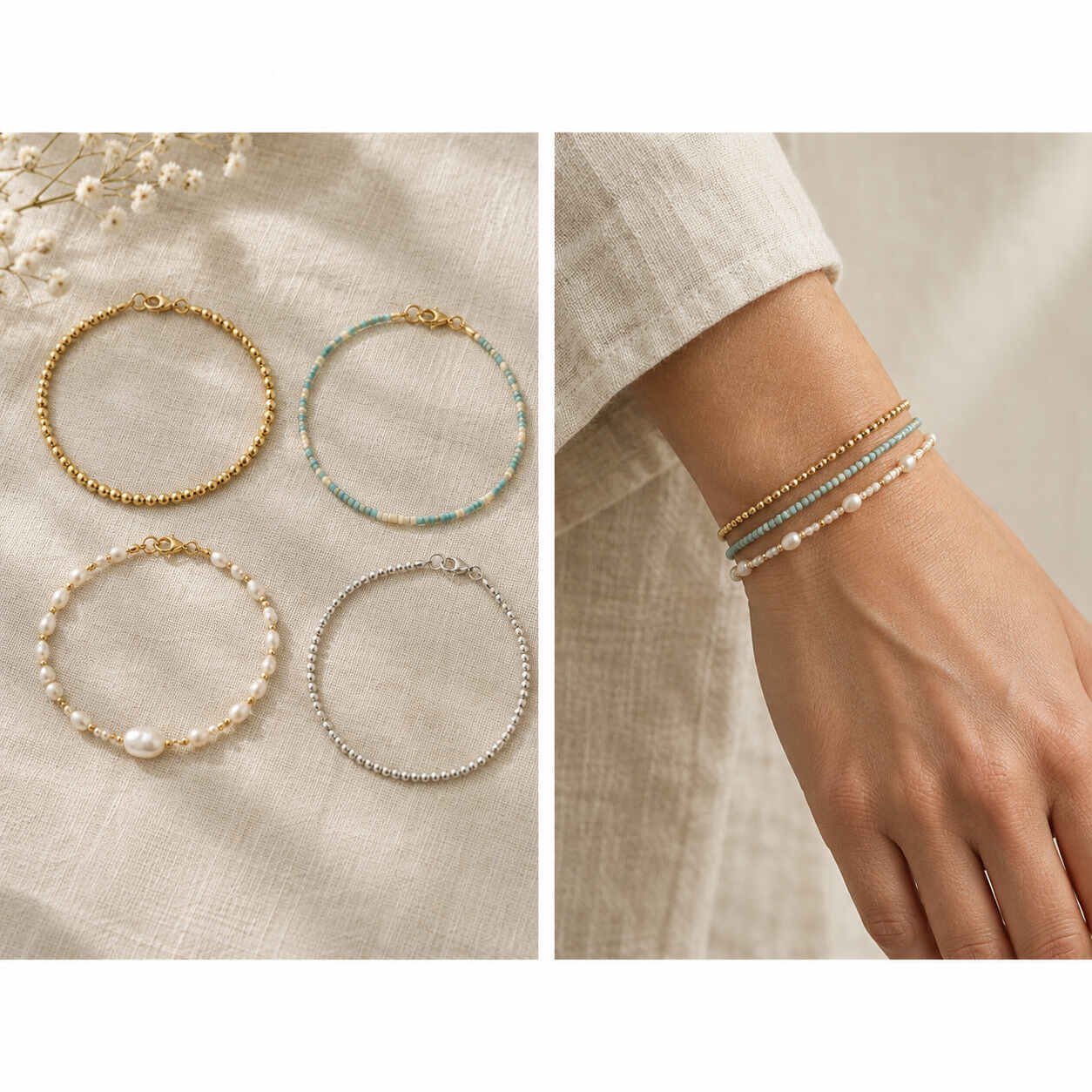
Consider your sleeves. Rolling them slightly may let the bracelet show, but there is no need to arrange every outfit around the jewelry. A glimpse of beads as you move can be part of the appeal.
For daily wear, choose combinations that feel easy. If you spend the day adjusting your bracelets or worrying about them, simplify the arrangement. The best everyday accessory often becomes something you enjoy without having to think about constantly.
Workwear and Polished Clothing
For work outfits or more polished dressing, dainty beaded bracelets can offer detail without taking attention away from the overall look.
A single bracelet may be enough beside a tailored sleeve. Neutral beads, restrained colors, or a simple metallic finish can create a composed impression. If you prefer color, choose a narrow strand that connects with another small element in the outfit.
Your work environment and tasks matter more than a universal styling rule. Some settings allow expressive accessories; others call for a quieter approach. Practical requirements may also influence what jewelry feels appropriate.
Choose a bracelet that supports the way you want to present yourself while remaining comfortable throughout the day. Understatement can be intentional rather than a compromise.
Dinners, Celebrations, and Special Events
A delicate bracelet can feel occasion-ready without becoming large or dramatic. The effect often comes from the surrounding outfit and the details of the bracelet itself.
Pearl accents, reflective beads, or a carefully chosen stack can complement a dress, silk-like blouse, or elegant separates. If your clothing has embellished cuffs, consider whether a bracelet adds anything or simply competes with them.
Look at your accessories as a group. Earrings, rings, and a bracelet do not need to match exactly, but they should allow one another space. A decorative bracelet may work best with simpler rings, while statement earrings can pair with a quieter wrist.
Special-event jewelry should still feel like you. Choose refinement through balance rather than assuming an occasion requires more pieces.
Give Dainty Beaded Bracelets as Thoughtful Gifts
Notice the Recipient’s Existing Style
A useful gift begins with observation. Look at the jewelry the person already wears rather than choosing only according to your own taste.
If you are browsing a collection labeled “Women dainty beaded bracelets,” use that label as a starting point rather than a complete guide to the recipient’s preferences. Look more closely at the individual designs: would she enjoy a quiet metallic strand, a subtle pearl accent, or a bracelet in her favorite color? A thoughtful gift should reflect the person who will wear it, not simply the category in which it appears.
Do they prefer gold-colored or silver-colored pieces? Do they enjoy bright colors, or do they usually choose neutrals? Are their accessories minimal, romantic, playful, or expressive?
A dainty bracelet can be a thoughtful choice when it reflects those preferences. If you want to introduce something different, keep one familiar element, such as their preferred metallic tone or favorite color.
You can also consider whether they wear bracelets regularly. Someone who usually chooses earrings may appreciate a simple, easy-to-wear bracelet more than a complicated stack. The aim is to give a piece that feels inviting rather than demanding.
Make Fit and Choice Part of the Gift
Sizing uncertainty can complicate bracelet gifting. If you do not know the recipient’s wrist measurement, review the available sizing and adjustment options carefully.
An extender or adjustable design may provide flexibility, but it still helps to understand the stated range. Do not assume that every adjustable bracelet fits everyone.
Check the seller’s exchange policy before purchasing. Giving the recipient an easy way to change the size or select another color can make the gift more considerate, not less personal.
A brief note can explain why you chose the bracelet. Mentioning a favorite color, a shared memory, or a detail that reminded you of them often adds more meaning than an elaborate presentation.
Care for Your Dainty Beaded Bracelets
Follow the Instructions for the Whole Bracelet
Care should be based on the bracelet’s actual materials and construction. A mixed-material design may require more consideration than its appearance suggests.
Read the seller’s instructions before cleaning or exposing the bracelet to water. A method suitable for one component may not be appropriate for another. When instructions are unclear, ask for guidance rather than trying an aggressive cleaning method.
Pay attention to cords, elastic, clasps, and decorative accents as well as the beads. These less visible parts still contribute to the bracelet’s condition.
A practical routine is better than a complicated one you will not maintain. Learn what the bracelet needs, handle it thoughtfully, and avoid assuming that every piece in your collection can be treated identically.
Store Pieces So They Are Easy to Find
Good storage is partly about protection and partly about convenience. When bracelets are separated and visible, you are more likely to wear the pieces you own.
Use small compartments, individual pouches, or another arrangement that keeps strands from becoming tangled together. Avoid creating a tightly packed pile that requires pulling bracelets apart.
Before putting a bracelet away, check whether it is clean and dry according to its care instructions. A quick look at the closure and strand can also reveal a problem before the next wear.
The goal is not to create a perfect display. It is to make your jewelry easy to select and handle. A simple storage system that suits your space can support a more consistent wearing routine.
Respond to Changes Instead of Ignoring Them
Occasionally inspect bracelets you wear often. Look for a clasp that no longer closes as expected, a strand that appears strained, or a component that has become loose.
If something changes, pause before continuing to wear the bracelet. Contact the maker or a suitable repair service to understand the options, particularly when the piece has personal value.
Avoid treating visible wear as a reason to discard a bracelet immediately. Some issues may be repairable, while others may indicate that the construction no longer suits your routine.
These observations can also guide future purchases. Noticing what you find comfortable, inconvenient, or difficult to maintain helps you choose the next bracelet more thoughtfully.
Shop With a Clear Comparison Checklist
Compare Details, Not Just Photographs
Product photographs are useful for judging style, but the written details help you understand what you are buying.
Compare bead dimensions, bracelet length, materials, closure type, and available adjustments. Look for photographs that show scale on a wrist and close-ups that reveal construction.
If several bracelets appeal to you, make a short comparison rather than repeatedly switching between images. Note what each offers and where information is missing.
A slightly less dramatic photograph may represent a bracelet that is better suited to your preferences. Conversely, an attractive image can hide uncertainty about fit or materials. Give both appearance and practical information a role in the decision.
Choose Value According to Your Priorities
The best value is not necessarily the lowest price or the most elaborate design. It is the bracelet that meets your priorities at a price you feel comfortable paying.
You may value a particular material, a handmade design, adjustable sizing, or a color combination you have not found elsewhere. Another person may prioritize simplicity and easy everyday wear.
Decide which qualities matter most before comparing prices. This helps you distinguish a meaningful feature from an appealing extra that you may not actually use.
Finally, imagine wearing the bracelet with three outfits you already own. If those combinations come easily, the piece has a clear place in your wardrobe. If you struggle to picture wearing it, take more time before deciding.
FAQ About Dainty Beaded Bracelets
What Are Dainty Beaded Bracelets?
Dainty beaded bracelets are bracelets with a delicate overall appearance, usually created through small beads, narrow proportions, restrained decoration, or a combination of these features. They can use metallic beads, glass, pearls, gemstone beads, or mixed materials.
“Dainty” is a style description rather than a precise sizing standard. Check measurements and worn photographs to understand how subtle or noticeable a particular bracelet will look.
Can I Wear a Dainty Beaded Bracelet Every Day?
Choose according to the bracelet’s materials, construction, care instructions, and your daily activities. A piece that suits quiet desk work may not suit every other routine.
Comfort matters as much as appearance. If you want an everyday bracelet, select a fit and closure you enjoy, then follow the maker’s guidance rather than assuming all delicate bracelets are designed for continuous wear.
How Many Dainty Beaded Bracelets Should I Stack?
There is no required number. Start with two bracelets and see whether the combination feels balanced and comfortable. Add another only if it contributes something you want, such as color, texture, or a focal detail.
A single bracelet is equally valid. Stacking should expand your styling options, not turn a simple accessory into an obligation to wear several pieces.
How Do I Choose the Right Bracelet Size?
Measure your wrist where you plan to wear the bracelet, then follow the seller’s sizing guidance. Check whether the listed measurement describes the full bracelet length or the intended wrist fit.
Consider bead size, closure style, and your preference for movement. If you are between sizes or the instructions are unclear, ask the seller for advice specific to that design.
Can I Mix Gold-Colored and Silver-Colored Bracelets?
Yes, you can combine them as a styling choice. To make the arrangement feel connected, repeat another feature, such as bead size, bracelet width, or a shared accent color.
You can also begin with one bracelet in each metallic tone and keep the rest of your accessories simple. Judge the combination by its overall effect rather than by a strict matching rule.
Are All Dainty Beaded Bracelets Waterproof?
Do not assume so. Water-related care depends on the materials and construction of the specific bracelet, including the strand, clasp, and decorative components.
Read the seller’s instructions and ask what any waterproof claim covers. If you do not have clear guidance, avoid treating the bracelet as suitable for swimming, showering, or other repeated water exposure.
Which Style Makes the Best Gift?
The best gift reflects the recipient’s preferences. A simple metallic bracelet may suit someone who wears minimal jewelry, while colored beads or a small charm may suit someone with a more expressive style.
Consider sizing and exchange options as well as appearance. A bracelet chosen with the person’s comfort and existing wardrobe in mind usually feels more thoughtful than one selected only for its presentation.
How Can I Make a Simple Bracelet Feel Personal?
Choose a color, bead combination, or charm that has meaning to you. You can also make the bracelet personal through the way you wear it, pairing it with a favorite ring, a familiar watch, or another bracelet connected to a memory.
Dainty beaded bracelets do not need dramatic details to feel special. Often, their appeal comes from a small feature you notice every time you put them on.