Ghost rings are one of the most interesting crossovers between gothic style, kawaii “spooky cute” culture and commercial fashion jewelry.
For B2B buyers, they offer a rare combination of strong visual impact, flexible price positioning and high storytelling value, which is exactly what modern consumers respond to on social media and in e‑commerce listings.
In this guide, we will look at What is a ghost ring? why they are trending, how they fit into global fashion jewelry assortments, and how professional buyers can source them efficiently from reliable manufacturers.
We will also explain how you can use search engine optimization (SEO) to attract organic traffic from retailers, brands and importers searching for ghost ring suppliers online.
1.What Are Ghost Rings?
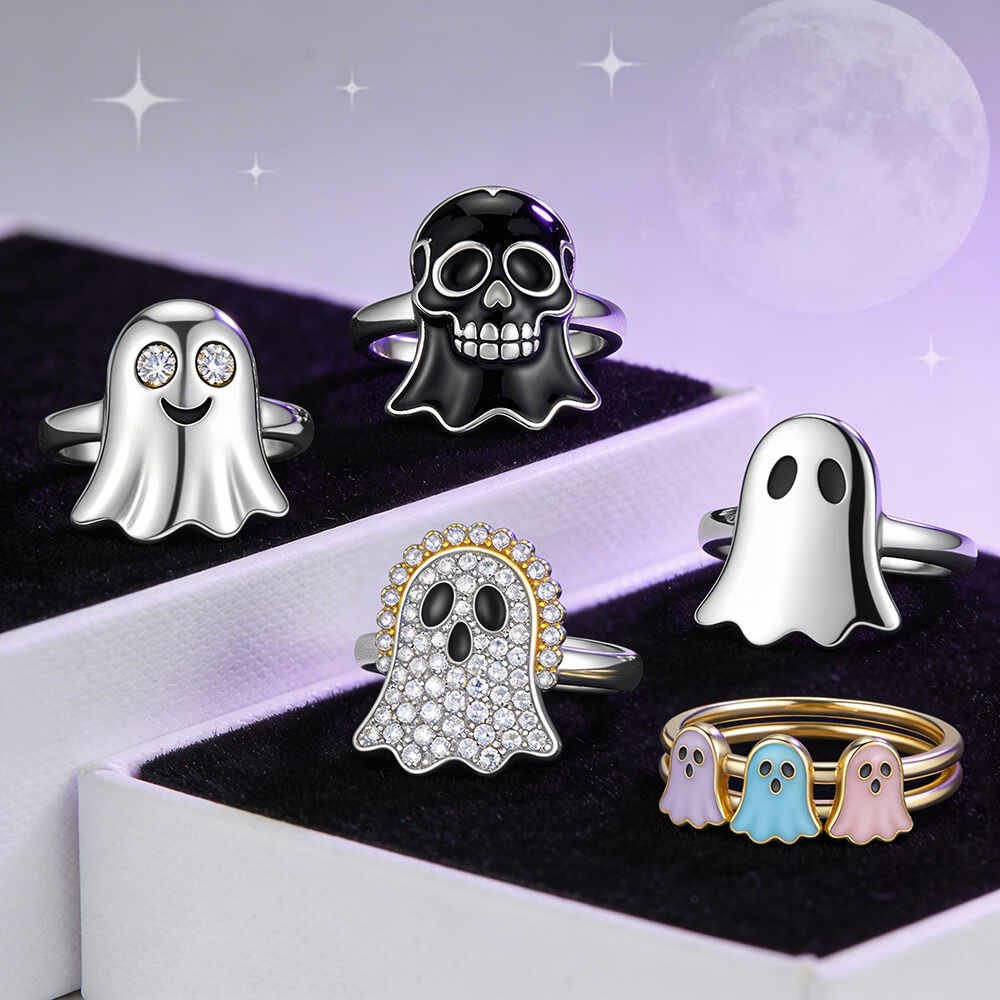
In the context of fashion jewelry, a ghost ring is a finger ring that features ghost‑inspired motifs or shapes.
Some designs look like the classic white cartoon ghost, with a rounded body and two hollow eyes.
Others combine ghost shapes with skull elements, gravestones, bats or moons to create a more gothic or occult mood.
There are also ultra‑minimalist versions where the “ghost” is suggested only through a silhouette or negative‑space cut‑out.
Ghost rings are usually made from:
- 925 sterling silver for mid‑to‑high‑end markets.
- Stainless steel or copper/zinc alloys with plating for value‑driven markets.
- Occasionally titanium or precious metals for small luxury collections.
Many designs use stones to increase perceived value: cubic zirconia, moissanite, glass crystal or colored stones create sparkling “eyes”, halo borders or pavé backgrounds.
Black enamel or oxidized silver is often added to accentuate the eyes and mouth of the ghost motif, giving a powerful contrast between light and dark.
From a product‑planning perspective, ghost rings sit between pure novelty pieces and durable evergreen items.
They clearly connect to Halloween and horror themes, but they are also part of a wider alternative‑fashion movement that is popular all year round.
2.Why Ghost Rings Are Trending With Young Consumers
To understand why buyers worldwide are adding ghost rings to their assortments, it helps to look at several cultural and commercial trends.
2.1 “Spooky cute” aesthetic
In recent years, young consumers have fallen in love with aesthetics that mix scary themes with soft, cute or pastel elements.
Instead of traditional horror, they prefer ghost characters with big round eyes, smiling faces and simplified shapes.
This style appears everywhere: in stickers, smartphone cases, nail art, clothing prints and, of course, jewelry.
Ghost rings are a natural accessory for this aesthetic because they are small, easy to style and very visible in photos.
2.2 Social‑media storytelling
Rings are one of the most photographed accessories on platforms like Instagram, TikTok and Pinterest.
Ghost rings are particularly “shareable” because they immediately suggest a story: spooky date night, Halloween party, witchy self‑care, horror‑movie marathon and more.
Influencers can easily build content around them, and brands can use them as the hero product in seasonal campaigns.
For B2B buyers, this matters because retailers ask for items that can generate user‑generated content without large marketing budgets.
A small, affordable ghost ring that looks great in a close‑up shot can drive significant traffic and engagement for a boutique or online shop.
2.3 Gothic and alternative fashion going mainstream
Gothic style, which used to be a niche subculture, has become widely accepted, especially in music, gaming and anime communities.
Black outfits, chokers, layered necklaces and dark makeup appear in everyday fashion, not only at concerts or clubs.
Ghost rings are a softer entry point into this style—less intense than a large skull ring, but still clearly alternative and expressive.
That makes them attractive to customers who want to experiment with darker aesthetics without fully committing to a heavy goth look.
2.4 Seasonal but also evergreen
There is a clear seasonal peak in demand around Halloween when brands launch themed collections.
However, search interest and online sales do not drop to zero after October.
Ghost rings continue to sell as part of horror fandom, gaming culture and alternative streetwear.
For buyers, this means ghost rings can be treated as a category that provides strong seasonal spikes plus a stable long tail of sales during the rest of the year.
3.Key Buyer Segments for Ghost Rings
When you position ghost rings on a B2B jewelry site, it is helpful to describe which types of retailers and brands they are best suited for.
This allows potential buyers to immediately see whether the category matches their own customers.
3.1 Alternative fashion stores
These are physical and online shops focusing on goth, emo, punk, occult or dark‑aesthetic fashion.
They usually sell black clothing, boots, corsets, chokers and statement rings.
Ghost rings fit perfectly into their existing assortments, particularly when combined with matching ghost earrings or necklaces.
For these customers, design uniqueness and quality are more important than ultra‑low price.
3.2 Fast‑fashion and lifestyle boutiques
Mainstream fashion boutiques need products that follow seasonal trends but still have a broad appeal.
For them, ghost rings are attractive as part of a limited Halloween collection or a “spooky season” capsule.
They often order a variety of designs at relatively low quantities per style, looking for flexible MOQs and fast delivery.
If your factory can produce mixed orders—many designs but small quantities per design—you will be more competitive with this segment.
3.3 Online gift and stationery shops
Ghost rings also sell well through gift shops, book stores and stationery retailers, especially those with kawaii or cartoon‑inspired products.
They can be marketed as friendship rings, couple rings or small surprise gifts.
These stores care about packaging and presentation: simple gift boxes, backing cards or themed pouches can significantly raise the perceived value.
3.4 Subscription boxes and influencer brands
Jewelry or lifestyle subscription boxes look for small, lightweight items that fit easily into packaging and have a clear wow factor.
Ghost rings are ideal because they offer a bold aesthetic in a tiny form factor.
Influencer‑led microbrands also look for distinctive products they can customize with logos or signature designs.
If your company offers OEM and private‑label services, this is a high‑margin niche worth mentioning in your B2B content.
4.Popular Materials, Styles and Collections
To help buyers plan a complete assortment, you should introduce the most popular materials and design directions for ghost rings.
4.1 Materials
- Sterling silver (925)
- Classic choice for mid‑range and premium markets.
- Supports detailed carving, oxidation and stone setting.
- Works well with moissanite or high‑grade cubic zirconia to create “fine jewelry” ghost rings.
- Stainless steel
- Hypoallergenic for most wearers and very durable.
- Suitable for unisex or men’s collections where strength and color stability matter.
- Can be plated in black, silver, gold or rainbow tones.
- Alloy with plating
- Best for affordable and trend‑driven markets.
- Allows very creative shapes at lower material cost.
- Requires careful quality control on plating thickness and colorfastness.
- Stones and inlays
- Clear and colored cubic zirconia for eye and halo effects.
- Moissanite for premium shine and higher retail price points.
- Enamel or resin in white, black, purple or neon colors to emphasize ghost details.
4.2 Design categories
Ghost rings can be grouped into several design families to make catalog browsing easier for buyers.
- Classic cartoon ghosts: soft outlines, smiling faces, often in white enamel or polished silver.
- Minimalist silhouettes: thin outlines or cut‑out shapes that suggest a ghost with very little detail; ideal for stacking.
- Gothic and horror themes: combine ghosts with skulls, crosses, coffins, chains or blood‑red stones.
- Couple and friendship sets: two complementary rings, for example one happy ghost and one shy ghost, or ghost plus tombstone.
- Adjustable open rings: one‑size‑fits‑most designs that reduce the risk of size mismatches in retail.
4.3 Collection ideas for buyers
To inspire your B2B visitors, you can propose complete collection concepts rather than only listing individual items.
- “Haunted Love” collection: ghost couple rings, heart‑shaped ghost motifs, black‑and‑red color combinations.
- “Pastel Spooks”: soft pastel enamel ghosts for kawaii‑style boutiques.
- “Dark Witchcraft”: heavy black or oxidized rings with ghost and occult symbols for serious goth customers.
- “Mini Ghost Stackers”: slim bands with tiny ghost shapes designed to be worn together with other stacking rings.
By offering ready‑made collection ideas, you help buyers visualize how ghost rings can work in their stores and encourage them to purchase multiple styles at once.
5.Ghost Rings as Seasonal and Evergreen Products
From a merchandising point of view, ghost rings are powerful because they work both as seasonal highlights and as long‑term catalog items.
5.1 Seasonal opportunities
Most retailers will schedule ghost ring promotions around Halloween, horror‑movie releases or local festivals.
For these campaigns, they need products ready in stores at least 4–6 weeks before the event.
Since international production and shipping take time, B2B buyers appreciate suppliers who clearly communicate recommended order deadlines.
In your article, you can suggest a simple schedule: for example, sampling in May–June, bulk orders in July, deliveries in August, and retail campaigns from September to October.
5.2 Evergreen sales
Even outside of Halloween, ghost rings serve customers who identify with goth, emo, witchy or horror‑themed lifestyles.
Online communities, gaming platforms and anime fandoms keep these themes alive all year.
That means retailers can stock a smaller but stable ghost ring range in their regular jewelry assortment.
If you position ghost rings as part of a “Gothic & Alternative” category, buyers will understand that they are not limited to seasonal sales.
6.Custom and OEM Ghost Ring Services
One of the strongest arguments you can present to B2B clients is your ability to develop exclusive ghost ring designs for their brand.
Many retailers want a unique ghost character or special engraving that no competitor can copy easily,It is custom ghost rings.
6.1 Design collaboration
Explain clearly how you work with clients on design:
- Clients can send hand‑drawn sketches, AI files, pictures or mood boards.
- Your design team converts these ideas into 3D CAD models, adjusting proportions for comfort and durability.
- You provide digital renders and, when needed, 3D‑printed or metal samples for approval.
- Revisions are possible until the client is satisfied with the design.
If you have in‑house designers who specialize in gothic or cartoon styles, highlight their experience.
For example, mention how many ghost or Halloween‑themed pieces you produce each year.
6.2 Brand identity and customization options
Buyers want more than just a ghost shape; they want their own brand identity embedded in the rings.
Common customization options include:
- Engraved logos or slogans inside the band.
- Specific facial expressions, accessories (hats, bows, crowns) or outfits for the ghost character.
- Special color palettes using enamel or stones that match the brand’s visual identity.
- Custom packaging such as printed boxes, velvet pouches or illustrated backing cards.
By listing these options, you make it easier for potential clients to imagine their own signature ghost ring collection.
6.3 MOQ, pricing and lead time for OEM
Custom projects usually have higher MOQs and longer lead times than standard stock designs.
Be transparent in your article:
- Typical MOQs might range from 50–100 pieces per design in steel or alloy, and higher for silver with stones.
- Sampling fees may be refundable when the order reaches a certain quantity.
- Development and sampling often require 10–20 days, while mass production can take 25–40 days depending on complexity and volume.
When buyers see clear numbers and a realistic timeline, they are more willing to start the conversation.
7.How to Choose the Right Ghost Ring Supplier
Because many search results for “ghost rings” are retail listings on marketplaces, professional buyers often struggle to find true manufacturers.
Use your article to educate them on what to look for in a supplier and subtly show that your company meets those standards.
7.1 Manufacturing and quality capabilities
A strong ghost ring supplier should:
- Have proven experience in casting, polishing and stone setting for small, detailed motifs.
- Use reliable plating processes that ensure color stability and resistance to tarnishing.
- Offer quality control at multiple stages—casting, finishing, assembly and final inspection.
- Provide certificates or test reports for nickel release and heavy metal content when required by EU or US regulations.
You can mention any relevant factory audits or certifications your company holds, such as ISO standards or compliance with specific markets.
7.2 Product development support
Many retailers and young brands do not have professional jewelry designers on staff.
They look for factories that can translate loose ideas into manufacturable designs.
Explain in your content how your team supports them: trend reports, design suggestions, material proposals and cost optimization.
7.3 Communication and after‑sales service
International buyers pay close attention to communication speed and transparency.
If you can offer dedicated sales managers, clear sample policies, repair or re‑plating services, and fast responses to complaints, highlight these points.
Good after‑sales service reduces risk for the buyer and sets you apart from anonymous marketplace sellers.
8.Practical Sourcing Tips for Buyers
To make the blog post more useful and trustworthy, add practical advice that experienced buyers will appreciate.
- Start with a mixed trial order to test sales—several designs in small quantities rather than a single large bet.
- Collect customer feedback quickly via social media and adjust designs or materials in the next order.
- Consider offering ghost ring sets (two or three rings together) to increase average order value.
- Test different price points: a low‑priced alloy line, a mid‑priced silver line and a higher‑priced moissanite line to see which your customers prefer.
- Pay attention to ring size curves for your main markets, and ask your supplier for guidance based on previous export data.
By sharing these tips, you show that your company understands real retail challenges, not just production.
9.SEO Strategy for Your Ghost Ring Landing Page
Because your goal is to attract organic traffic from search engines, the blog article should follow SEO best practices while still reading naturally.
9.1 Focus keyword and intent
Your main keyword is “ghost rings”.
However, users searching this phrase may have different intentions:
- Retail customers looking to buy a single ring.
- B2B buyers searching for wholesale or manufacturers.
- Users interested in non‑jewelry topics (for example firearm sights, which also use the term “ghost ring”).
By clarifying in your title and introduction that the article is a wholesale guide for jewelry buyers, you signal your target intent to both readers and search engines.
Secondary keywords such as “ghost rings wholesale”, “ghost rings for sale”, “custom ghost ring manufacturer” and “moissanite ghost ring supplier” help refine the relevance.
9.2 Title tags and headings
Create a title tag that includes the main keyword and a benefit, such as:
- “Ghost Rings Wholesale Guide – Custom OEM Jewelry Manufacturer”
- “Ghost Rings for Gothic Fashion – B2B Jewelry Sourcing Guide”
Use H2 and H3 headings throughout the article that naturally incorporate related phrases:
- “Popular Materials for Ghost Rings”
- “How to Choose a Ghost Ring Supplier”
- “Custom Ghost Rings and OEM Services”
This structure helps search engines understand the content and also allows busy buyers to skim for the information they need.
9.3 On‑page optimization
Within the article:
- Mention the main keyword near the beginning and a few times in the body, but avoid unnatural repetition.
- Use related words like “gothic rings”, “Halloween jewelry”, “moissanite ghost rings”, “alternative fashion rings”.
- Add internal links from this article to your category pages for gothic rings, Halloween collections or moissanite jewelry.
- Optimize your URL, for example: /blog/ghost-rings-wholesale-guide/.
9.4 Image optimization
Since ghost rings are highly visual, you will likely include multiple product and lifestyle images.
Optimize them by:
- Compressing files and using modern formats such as WebP to keep load time under three seconds.
- Writing descriptive alt text, for example “sterling silver ghost ring wholesale for Halloween collections” or “custom moissanite ghost ring with brand logo”.
- Using filenames that include the keyword, such as ghost-ring-wholesale-silver.jpg.
These steps help your images rank in image search results and support the overall page ranking.
9.5 Schema markup and FAQ
Adding FAQ structured data to your page can help Google display question‑and‑answer snippets directly in search results.
At the end of this article, we include a ready‑to‑use FAQ section.
Your technical team can mark it up with appropriate schema so that each question has a chance to appear in the “People Also Ask” box.
10.Off‑Page SEO and Authority Building
To compete with large marketplaces and established sites, you also need external links that point to your ghost ring article.
10.1 Guest posts and industry content
Offer well‑written guest articles about gothic jewelry trends, Halloween merchandising or alternative fashion to industry blogs, online magazines and B2B sourcing portals.
In those articles, include a natural link back to your ghost ring guide as a deeper resource for readers who want to purchase products.
10.2 Community participation
Join relevant online communities: jewelry forums, fashion buyer groups, Reddit subreddits and Q&A sites.
Provide helpful, non‑spammy answers to questions about sourcing goth jewelry, planning Halloween collections or evaluating suppliers.
When appropriate, reference your ghost ring article as a detailed guide, not as a hard sales pitch.
10.3 Collaboration with influencers and buyers
If you collaborate with influencers or large retailers, ask whether they are willing to link to your ghost ring landing page from their blogs or press pages.
Case studies about successful ghost ring campaigns or co‑designed collections can generate both brand awareness and SEO value.
11.Call to Action for B2B Buyers
After educating readers about ghost rings and explaining how to source them, end your article with a clear and confident call to action.
For example:
“If you are planning your next gothic or Halloween jewelry collection, our factory can help you develop and produce unique ghost rings tailored to your customers.
Contact our sales team today for the latest catalog, sample policy and quotation. We support low MOQs for test orders and offer full OEM/ODM services for brands and retailers worldwide.”
Encourage visitors to:
- Request a digital catalog or price list.
- Order sample sets of your best‑selling ghost ring designs.
- Share their own ideas for custom ghost or horror‑themed jewelry.
A strong call to action turns informational traffic into real business leads.
Ghost Rings FAQ
You can place the following FAQ at the end of your article and, if possible, mark it with FAQ schema.
Q1: What is a ghost ring in jewelry?
A ghost ring in jewelry is a ring that features a ghost‑shaped or ghost‑inspired motif.
It may show a full cartoon ghost, a minimalist silhouette or a combination of ghost and gothic symbols such as skulls or crosses.
These rings are usually made from metals like sterling silver, stainless steel or alloy and may include stones or enamel for decoration.
Q2: Are ghost rings only popular during Halloween?
Ghost rings see their strongest sales during the Halloween season and related events, but they are not limited to that period.
They also sell well throughout the year to fans of gothic fashion, horror movies, gaming culture and “spooky cute” aesthetics.
For many retailers, ghost rings are part of their permanent alternative‑fashion collections.
Q3: What materials are best for wholesale ghost rings?
For mid‑range and premium markets, 925 sterling silver combined with moissanite or high‑quality cubic zirconia is a popular choice.
For more affordable lines, stainless steel or plated alloys offer good durability at lower cost.
The best material depends on your target price point, brand positioning and customer expectations.
Q4: Can I customize ghost rings with my own logo or character?
Yes, many manufacturers offer OEM and ODM services for ghost rings.
You can customize the ghost’s facial expression, outfit, stone color and overall shape, and you can also add engraved logos or slogans inside the band.
Custom packaging such as branded boxes or backing cards is usually available as well, subject to minimum order quantities.
Q5: What is the typical MOQ for ghost ring wholesale orders?
Minimum order quantities vary by material and production method.
For stainless steel or alloy ghost rings, typical MOQs start around 50–100 pieces per design, while sterling silver or moissanite rings may require higher quantities because of material and labor costs.
Discuss your target budget and sales plan with your supplier to find a suitable MOQ.
Q6: How long does production take for ghost rings?
Production time depends on design complexity, order quantity and factory workload.
As a general reference, developing and approving samples may take 10–20 days.
Mass production for a standard order usually requires 25–40 days, after which you need to add international shipping time.
To be safe for seasonal campaigns like Halloween, it is wise to confirm orders several months in advance.
Q7: How should retailers price ghost rings?
Retail pricing is influenced by material, branding and market segment.
Affordable alloy ghost rings may be priced similarly to other fashion rings, while sterling‑silver or moissanite ghost rings can command premium prices close to fine jewelry.
Many retailers use a keystone or higher markup (for example 2.5–3.5 times wholesale cost) depending on their positioning and marketing expenses.
Q8: How can an online store promote ghost rings effectively?
Online stores can highlight ghost rings with themed product photography, Halloween or gothic lookbooks and short video content.
They can run limited‑time “spooky season” promotions, collaborate with influencers who love horror or alternative fashion, and encourage customers to share their own styling photos with branded hashtags.
Bundling ghost rings with matching earrings or necklaces is another way to increase order value.
Q9: Are ghost rings suitable for sensitive skin?
This depends on the materials used.
High‑quality stainless steel and properly tested sterling silver are generally safe for most customers, especially when they are nickel‑free.
If you have many customers with sensitive skin, choose suppliers who can provide material certifications and consider promoting hypoallergenic lines.
Q10: How can I start a ghost ring private‑label brand?
To launch a private‑label ghost ring brand, first define your target customers and price range.
Then work with a manufacturer that offers OEM services to develop a few hero designs that express your brand personality.
Order samples, test them with your audience through social media or small pre‑orders, and refine the designs based on feedback.
Once you see clear demand, expand into full collections and build consistent branding across packaging, website and marketing.